

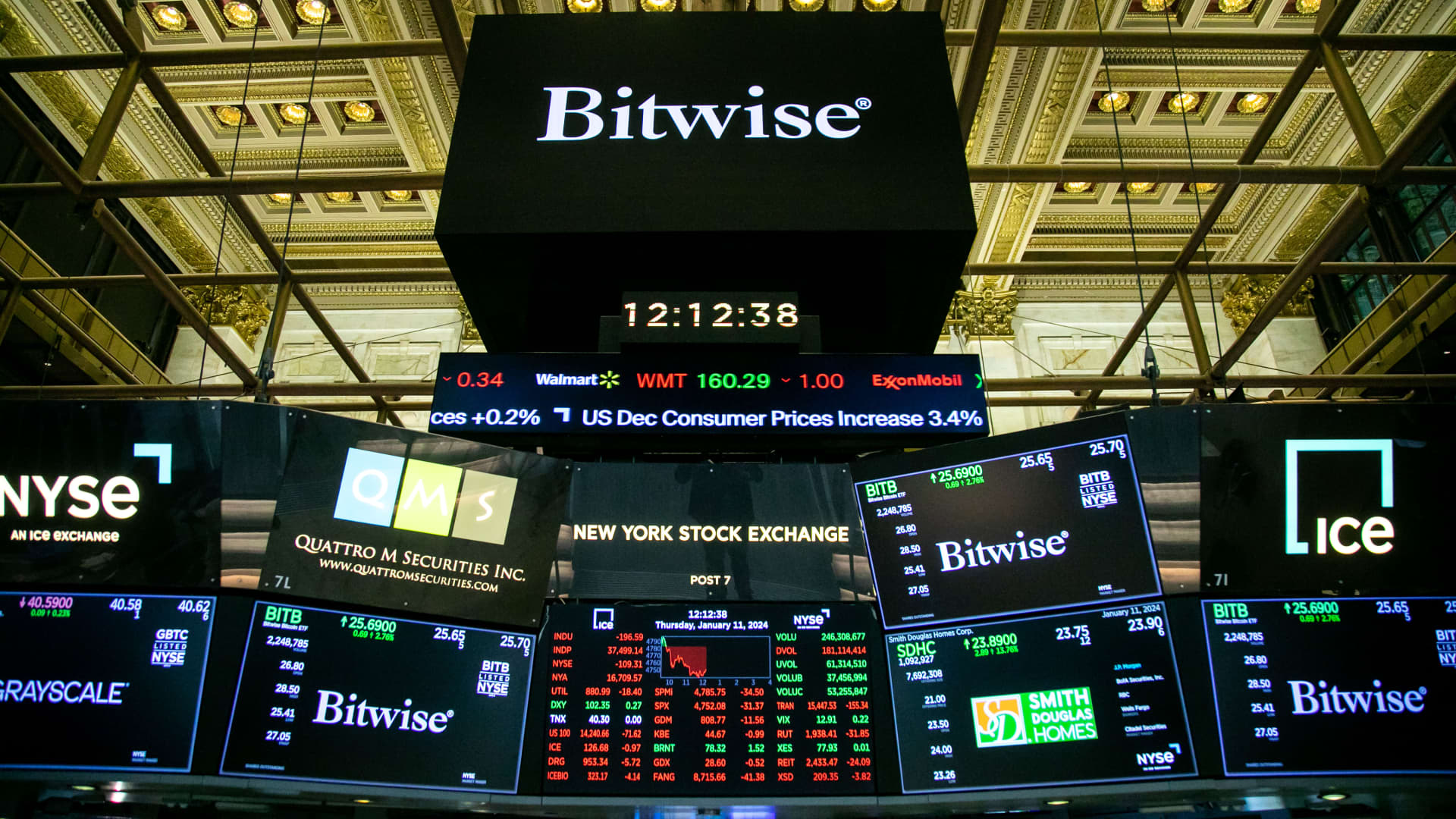
Bitwise Spot Bitcoin ETF (BITB) Signaling on the floor of the New York Stock Exchange (NYSE) in New York, USA, on Thursday, January 11, 2024, with the trade that begins in the first funds quoted in the US stock market. UU. Which directly invest in the largest cryptocurrency.
Bloomberg | Bloomberg | Getty images
If Larry Fink’s vision – CEO or Black rockThe world’s largest money administrator: all assets, from shares to bonds and real estate and more would be negotiable online, in a block chain.
“Each asset can be token,” Fink wrote in his annual letter recently to investors.
Unlike traditional paper certificates that mean financial property, tokens live safely in a block chain, which allows buying, selling and transferring snapshots without paperwork or waiting, “just like a digital,” he wrote.
Fink says it would be nothing less than a “revolution” to invest. Think of 24 -hour markets and a commercial settlement process that can be reduced in seconds from a process that today can still take days, with billions of dollars reinvested of imediatrry in the economy.
But there is a big problem, a technological challenge that gets along the way: the lack of a coordinated system of digital identity verification.
While technology experts say that Fink’s idea is not unlikely, they agree that there are cybersecurity challenges ahead to work.
Verify asset owners in the world or the deep falsifications of AI
Today, it is not easy to verify online that the person with whom he is interacting is that person due to the prevalence of Deepfakes and the sophisticated cybercriminals, according to Christina Hulka, executive director of the safe technology and piananza. As a result, having a unified verification system would be useful because there would be cryptographic validation that people are the ones who say they are.
“He [financial services] The industry focuses on how to build a zero confidence framework for identification. You don’t trust anything until it is verified, “said Hulka.” The challenge is to gather everyone about which technology using it does the simplest and without problems for the possible consumer, “he added.
It is difficult to say precisely how a broad -based digital verification system worked, but to support a totally tokenized financial structure, at least one system would need to meet strict safety requirements, partly those linked rules, such as those like those like those like those who are similar, such as the technology officer as the technology officer, such as Nike Nike, like Nike, like Nike Nike Nike.
At the same time, the system would need to be low friction and fast. There is no shortage of technical tools today, especially in the field of cryptography, which can effectively unite a digital identity to a transaction, Ramzan said. “Fifteen to 20 years ago, this conversation would have a non -initial leg,” he added.
There are bone of some successes with programs like this worldwide, according to Ramzan. The Aadhaar system of India is an example of a digital identity framework at a national scale. It allows the majority of the population to authenticate transactions through mobile devices, and is integrated into public and private services. Estonia has an electronic identification system that allows citizens to do everything from banking to online vote. Singapore and EAU have also implemented strong national identity programs linked to mobile infrastructure and digital services. “While these systems differ in how they handle problems such as privacy, they all share a key feature: the leadership of the centralized government that promoted standardization and adoption,” Ramzan said.
Centralized personal data are a great objective for cybercriminals
While a centralized system resolves a challenge, the storage of information on personal identification information and biometry is a security risk, said David Mattei, a strategic advisor in the practice of fraud and AML in Data Insight Technology, Insurance, Companics.
In particular, there are reports of legs or stolen data from the Aadhaar system of India. And last year, the Government of El Salvador had personal data or 80% of its stolen citizens of a centralized citizen identity system administered by the Government. “Many security experts make the lawyer of the law have a centralized security system that you are a child or that you like the pot at the end of the rainbow that each scammer tries to have in their hands,” Mattei said.
In the US, there is a long -standing preference for decentralized systems for identity. In mobile devices, facial identification and the identification of fingerprints are not carried out by centralizing all those data in one place in Apple or Google, but for failures the data in a safe module on each mobile device. “This makes it much more difficult, if not impossible, that the scammers steal that data and mass,” Mattei Maid.
Larry Fink, Executive Director of Blackrock Inc., in Berlin’s global dialogue in Berlin, Germany, on Tuesday, October 1, 2024.
Bloomberg | Bloomberg | Getty images
Digital driving licenses offer a warning story
A significant coordinated effort would be needed for the use of a national identity system for identity verification.
The identity systems in the United States today are fragmented, said Ramzan, giving the example of the state departments of motor vehicles. “To advance, we will need a national cohesive strategy or a way of better coordinating identity through state and federal levels,” he said.
That is not an easy task. Let’s take, for example, the effort that many states are making to adopt digital driving licenses. Around a quarter of today’s states, including Utah, Maryland, Virginia and New York, issue mobile driving licenses, MDLConnection, an online resource of the Secure Technology Alliance. Other states have valid pilot programs, they have promulgated legislation or are studying the problem. But this company is quite British and is running for several years.
Implementing a national identity verification system would be a “mass company and would require almost all companies that do online business to adopt a government standard for identity verification and authentication,” Mattei said.
Competitive forces are another problem to deal with. “There is an ecosystem or suppliers that sacrifice verification and authentication solutions that would not want a centralized system for fear of leaving the business,” said Mattei.
There are also important data privacy obstacles to overcome. The states and the federal government would have to coordinate to solve governance problems, and this could cause concerns of “older brother” about the extent that the federal government could monitor the activities of its citizens.
Many people have “a bit of allergic reaction” when something similar to a national identification arises, said Ramzan.
Fink has been pressing the SC to find the problem
The idea is not new to Fink. In Davos earlier this year, he told CNBC that he wanted the SEC to “quickly expand the tokenization of actions and bonds.”
There is a Blackrock’s own interest at work and possible cost savings for the company and many others, of which Fink has spoken. In recent years, Blackrock has been dragged into political battles and demands about its vote of a massive amount of actions held in its funds on ESG issues. “We would never have to vote more about a vote of power,” Fink to CNBC told Davos, referring to the “Blackrock Tax.”
“All owners would be notified of a vote,” he said, that would depend on the cost of ownership of shares and bonds.
It is clear for Fink’s decision to grant prominent placement in his annual letter, even if he was in third place in the order of the problems he covered behind the protectionism policy and the growing role of private markets, which do not relieve themselves. And what is needed to make this reality, according to him, is a new digital identity verification system. The letter has little details, and Black Rock refused to elaborate, but, at least on the surface, the solution for Fink is clear. “If we take the construction of an efficient and accessible financial system seriously, defend only tokenization won.
Blockchain continues to evolve and people are learning to understand it better. Consequently, there are initiatives in progress to think how the United States can achieve a broad -based identity verification system, said Hulka. There are technical ways to do it, but finding the correct way that works for the country is more a challenge, since it has to be interoperable. “The goal is to reach a point where there is a way to verify identity in multiple services,” he said.
In all, there will be a turning point for the financial services industry where it becomes a commercial imperative, said Hulka. “The question is when or course.”
