

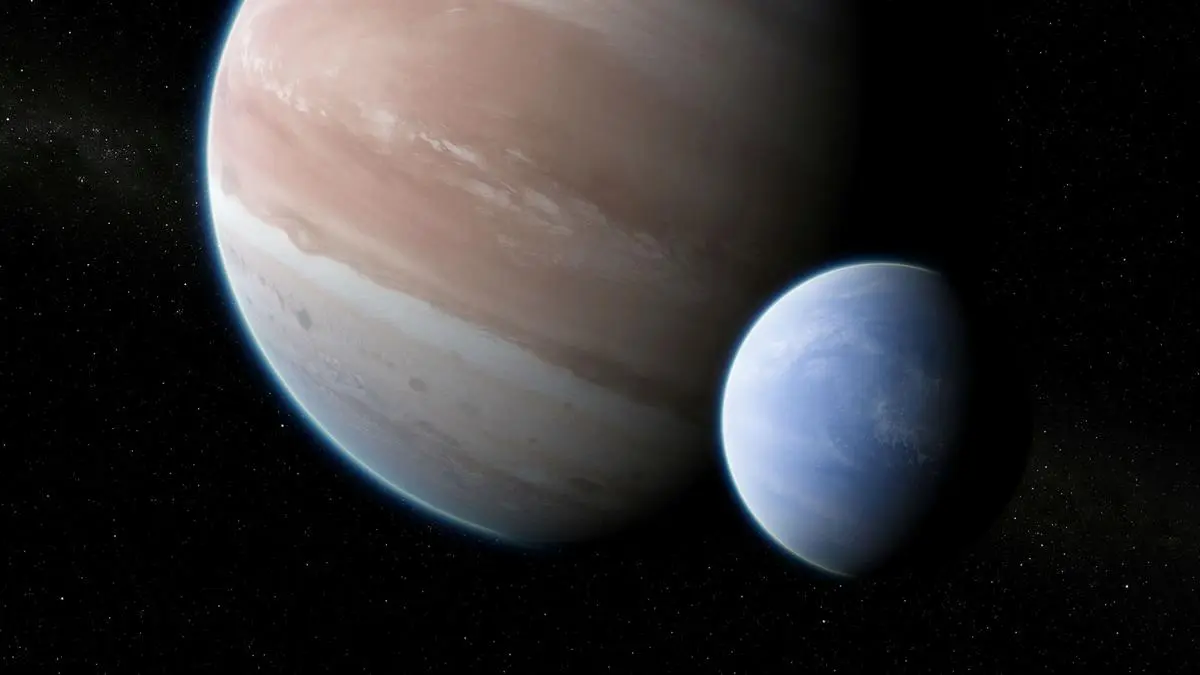
In a possible historical discovery, scientists who use the James Webb space telescope have obtained what they call the strongest signs so far as possible beyond our solar system, detecting in the thmhere of an alien planet the biological processes of chemical fingerprints.
The two gases, dimethyl sulfide, or DMS, and dimethyl disulfide, or DMDs, involved in the planet’s webb observations called K2-18 B, are generated on earth by living organisms, mainly algae of microbial life.
This suggests that the planet can be full of microbial life, the researchers said. They highlighted, in principle, that they are not announcing the discovery of real living organisms, but rather a possible biosignura, an indicator of a biological process, and that the findings are meanings, they needed observations.
However, they expressed emotion. These are the first indications of an alien world that is possible inhabited, said Astrophysicist Nikku Madhusudhan, of the Institute of Astronomy of the University of Cambridge, principal author of the study published in The Astrophysical Journal Letters.
“This is a moment of transformation in the search for life beyond the Solar System, where we have shown that it is possible to detect biosignas on enhanceable potentiatals with current facilities. We have entered the era of observation.
Madhusudhan said that there are several efforts in progress looking for signs of life in our solar system, including several statements of environments that could be conducive to life in places like Mars, Varus and several frozen moons.
K2-18 B is 8.6 times more massive than Earth and has a diameter approximately 2.6 times larger than our planet.
Orbit in the “habitable zone”, a distance where liquid water, a key ingredient for life, can exist on a planetary surface, around a narrower red dwarf star and less luminous than the sun, located about 124 years of the earth. A light year is the distance that travels in a year, 5.9 billion miles (9.5 billion km). Another planet has also been identified by orbiting this star.
A ‘world hycean’
About 5,800 planets have been discovered beyond our solar system, called Exoplanets, since the 1990s. Scientists have raised the hypothesis of the existence of exoplanets called Hycean worlds, covered by an ocean of liquid water habitable by microorganisms and with an atmosphere rich in hydrogen.
Previous Webb observations, which was launched in 2021 and became operational in 2022, identified the methane and carbon dioxide in the atmosphere of K2-18 B, the first time that the carbon-based molecules were discovered the hobsphere of an exoplanet.
“The only scenario that currently explains all the data obtained so far from JWST (James Webb Space Telescope), including past and present observations, is one in which K2-18 B is a world of Hycean full of life,” Madhusudhan. “However, we must be open and continuous exploring other scenarios.”
Madhusudhan said that with the worlds of Hycean, if they exist, “we are talking about microbial life, possible as what in the oceans of the earth.” Their oceans have the hypothesis of being warmer than the lands. When asked about possible multicellular organisms or even intelligent life, Madhusudhan said: “We will not be able to answer this question at this stage. The basic line assumption is of a simple microbial life.”
DMS and DMDS have been predicted, both of the same chemical family, as important exoplanet biosignuras. Webb discovered that one or the other, or possible, were present in the planet’s atmosphere with a 99.7% confidence level, which means that there is still a probability of 0.3% that observation is a statistical chance.
Gases were detected at atmospheric concentrations of more than 10 parts per million per volume.
“As a reference, this is thousands of times higher than its concentrations in the atmosphere of the Earth, and cannot be explained without biological activity based on existing knowledge,” said Madhusudhan.
Scientists who are not involved in the study advise circumspective.
“The rich data of K2-18 B make it a tempting world,” said Christopher Glein, the main scientist of the Space Sciences Division of the Southwest Texas Research Institute. “These latest data are a valuable contribution to our understanding. However, we must be very careful to test the data as thoroughly. I hope to see the independent work in data analysis from next week.”
Transit method
K2-18 B is part of the “subneptune” planet class, with a diameter greater than that of the Earth but less than that of Neptune, the smallest gas planet in our solar system.
To determine the chemical composition of the atmosphere of an exoplanet, astronomers analyze the light of its host star as the planet passes in front of the perspective of the Earth, called Transit Method. As the planet travels, webb can detect a decrease in stellar brightness, and a small stellar light fraction passes through the planetary atmosphere before being detected by the telescope. This allows scientists to determine the constituent gases of the planet’s atmosphere.
Webb’s previous observations on this planet provided a tentative DMS touch. Its new observations used a different instrument and a different wavelength light range.
The “Holy Grail” or the science of Exoplanet, said Madhusudhan, is to find evidence of life on a planet similar to Earth beyond our solar system. Madhusudhan said that our species for thousands of years is wonderful “we are alone” in the universe, and now they could be a few years of detecting a possible alien life in a world of Hycean.
But Madhusudhan still urged caution.
“First we need to repeat the observations two or three times to ensure that the signal we are seeing is robust and increase the importance of detection” to the level in which the probabilities of a statistical chance are below approximately one in one million, Madhusudhan.
“Secondly, we need more theoretical and experimental studies to ensure that there is another abiotic mechanism (one that does not imply biological processes) to do DMS or DMD in a planetary atmosphere such as Hally Bcheh studies. Biosignuras even for K2-18 B, we need to remain open and pursue other possibilities,” said Madhusudhan.
Then, the findings represent “a great if” about whether the observations are due to life, and anyone is interested prematurely that we have detected life, “said Madhusudhan.
Posted on April 17, 2025