

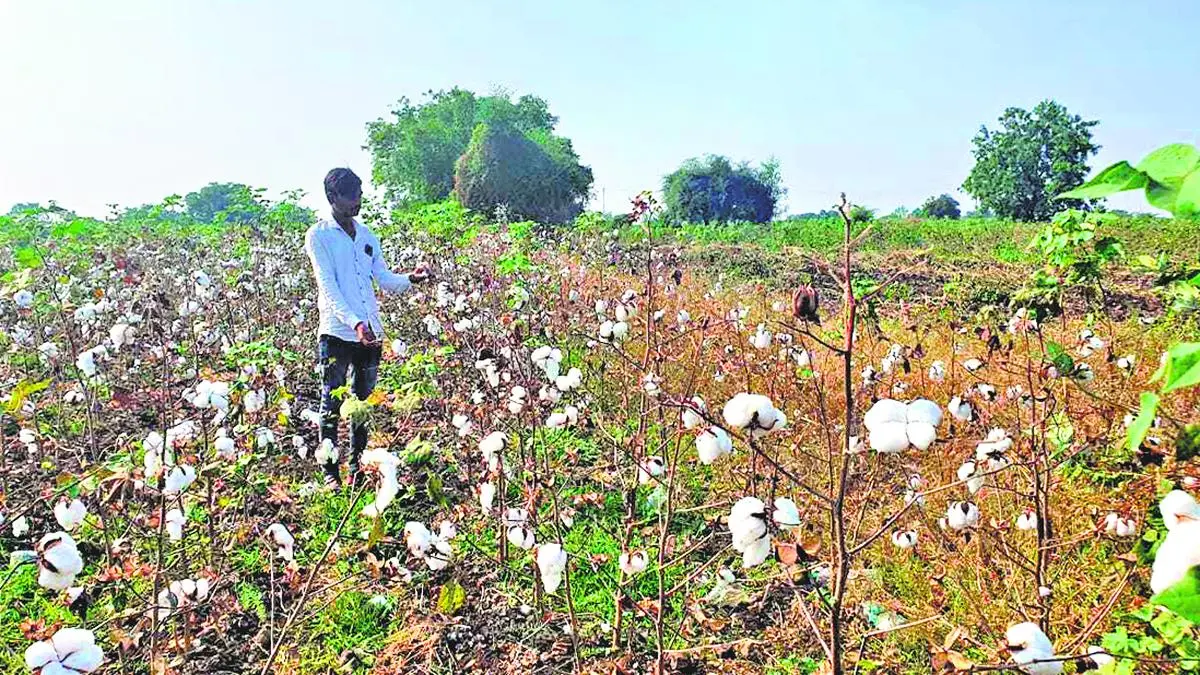
The low cotton area in Punjab has decreased significantly in the last years of 2.68 Lakh hectares (LH) in 2018-19 to 0.97 LH in 2024-25
There has been a bone reduction in cases of pest attacks after the launch of a pilot project last season to a monitor and control the infestation of pink earthworm (PBW) in the cotton cultivation in Punjab.
But, the farmers’ reaction is mixed, since some of them have complained that he did not help handle PBW. As a result, they incurred losses. However, there is unanimity between them to reduce the low cotton area, partly due to PBW and mainly due to the lack of water availability.
The low cotton area in Punjab has decreased significantly in the last years of 2.68 Lakh hectares (LH) in 2018-19 to 0.97 LH in 2024-25, resulting in the production that also decreases from 12.22 Lakh Fales. The main reason for the increase in PBW, a highly destructive cotton plague, is attributed to the stacking of cotton crop waste near the fields.
Praise for the project
This increases infestation levels, especially when cotton stems, unopened capsules and fluff residues are stacked near agricultural fields, allowing the larvae to survive through the diapause and emerge subsections.
“I thought the machine helped us get the alert in time, the PBW is not managenclet even after aerosols,” said Beant Singh, a farmer in the Sri Muktsar Sahaib district. He said he would reduce the low cotton area to 5-6 acres from 15-16 acres before, mainly due to PBW, as well as in the water problem. He said the performance has decreased considerably, reducing its profits as it cultivates in the leased country.
On the other hand, Roop Singh, from the Faridkot district, said the area plans to 6-7 acres from 15 acres last year due to the availability of water, but praised the pilot project of the government that helped manage PBW and also lowered its drop.
Evaluation of the pilot
According to the evaluation of project results, the implementation helped a significant detection of pests, management and profitability efficiency compared to traditional methods –38.6 percent reduction in the use of pesticides while maintaining the damage of PBW under control and 18.54 under control and 18.54, belonging under control and 18.5.5 .. present under control and 18.5.5. 18.54.54.54.54.5.ODAGE UNDERAL CONTROL AND 18.54.5.ODAGE, Under -control and 18.54.N. The potential of the traps to to improve the productivity of cotton while reducing chemical dependence.
Last year, the Cotton Cotton Research Institute (ICRC) based in NAGPUR implemented the project in 18 villages of three key districts of Punjab cotton cultivation, financed by the Ministry of Agriculture of the Union (Paunabgurmation) and State Gunjab.
The ICRC implemented its own intelligent pheromone trap technology based on Al to overcome the limitations of conventional traps. The smart trap system includes a single plate computer, a camera module, a meteorological sensor and a GSM transmitter, all fed by a solar panel with a rechargeable battery. A control unit triggers the chamber module, set on the earth, at intervals per hour to capture images of attramed insects, according to Prashant Kumar Dash, deputy director general of ICAR.
Warning system
The system optimizes and transmits the combined data (corresponding trap capture images and meteorological parameters) through a 4G GSM/Wi-Fi module to a remote server. An automatic learning algorithm driven by Al (Yolo) then processes the images, counts the insects trapped and delivers the data analyzed to the end users through mobile or PC applications, together with relevant weather information.
When correlating the stairs in real time with meteorological data, pest dynamics in a wide area can be better understood. This, in turn, facilitates the development of a reliable pest freewarning system and improved pest management practices in cotton cultivation, agreed to the pilot project evaluation report.
Having real time monitoring is essential to design timely and profitable management strategies to control PBW, scientists said that the dissemination of alerts and appropriate pest notices for farmers helped maintain damage below the levels (ETL).
Posted on April 18, 2025