

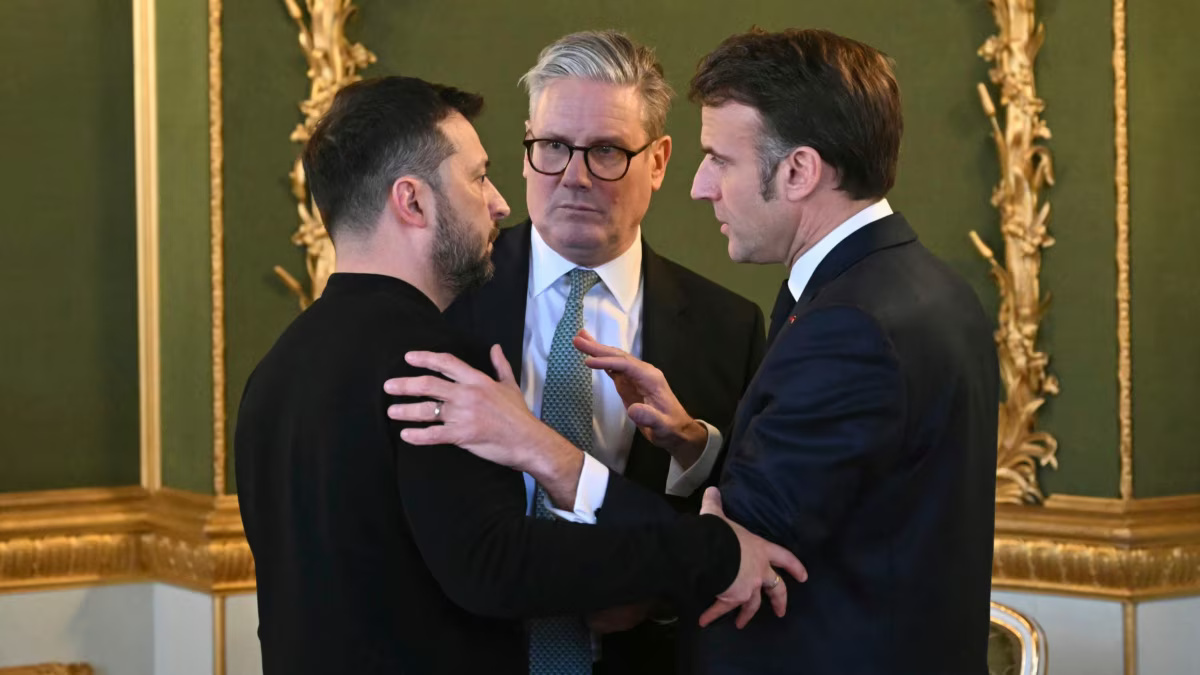
Even before Ukrainian President Volodymyr Zelensky’s car crash meeting at the White House last month, Britain’s Prime Minister Keir Starmer had talked confidently of putting British boots on the ground in Ukraine – widely understood to mean land forces – in the event of a ceasefire with Russia.
After the Washington mauling, Starmer – along with French President Emmanuel Macron and other European leaders – quickly doubled down on their pledges of support for Ukraine’s leader.
“This is not a moment for more talk,” Starmer said following a major gathering of heads of state and government leaders in London the next day. “It is time to act.”
Now, though, four weeks on and after two further major meetings of European leaders, the overwhelming sense is that of a process inexorably slowing down. We should probably not be surprised.
The preferred terminology now is of a “reassurance force” for Ukraine – talk of European “peacekeepers” is no longer in the lexicon. Such a force would not act on the front line, Macron told reporters after Thursday’s meeting in Paris, and it would not act on behalf of Ukrainian forces.
Recent reports have suggested that London, in particular, might be going cool on the idea of putting troops on the ground in Ukraine, but Macron insisted nothing has so far been ruled out.
“We are looking into the air, at sea, and on the ground as well. Nothing is excluded,” he said, adding, “that (reassurance) force will be deployed in Ukraine.”
Further details will come in due course, but French and British military chiefs now have the task of working with their Ukrainian counterparts to establish the number of troops that would make up such a force and where they might be located, as well as their capabilities, he said.
In military parlance, it is time to get to work on the “operating concept” that would underpin any such force. What are the possible threats that it would likely face? What would be the rules of engagement?
These are not simple matters and will likely take weeks to nail down. Inevitably, answers to those questions need to assume limited, or non-existent, US participation, which will likely further slow down planning.
For Andriy Zagorodnyuk, a former defense minister of Ukraine, ambitions need to be realistic.
He points to the obvious logistical challenges presented by his country’s massive 1,000-kilometer (600-mile) front line with Russia, and the low probability that Starmer and Macron would approve rules of engagement that could see European troops entering into direct combat with Russian soldiers. A forward deployment of British or French land forces would be an ineffective endeavor, he warns, but so too could a less far-reaching commitment.
“There have been so many discussions that Europe would step in and help with security arrangements, but if they end up sending 10,000 people to stay in Kyiv, unable to leave the city, that’s certainly not going to change anything in Russia’s calculations,” he told CNN.
In fact, with a negligible deterrence effect, such a move could actually make Europe emerge weaker. The temptation for Russia to humiliate London and Paris – by breaking any ceasefire with an attack carried out hundreds of miles away from British and French troops stuck in the capital – could prove hard to resist.
In a paper written for the London-based Royal United Services Institute, a defense think tank, Zagorodnyuk, along with two colleagues, argues that a better option for Europe could be “airmen boots” on the ground – a commitment to police Ukraine’s skies from Russian strikes.
Such a protection would almost certainly mean British, French and other warplanes stationed in Ukraine, along with aircrews and accompanying logistical support. It might be that Europe only provided cover over western and central Ukraine, he says, but even that would at least allow Ukraine to devote all of its forces to defending the eastern part of the country.
Even a reassurance force that extended no further than putting air assets inside Ukraine would still be a major step for Europe. But the potential credibility risks, while still extant, would surely be lower than with any deployment of land forces.
At the same time, Europe needs to be extremely careful. Managing expectations in the run-up to any possible announcement is also key. The credibility of any eventual deployment will be judged to a considerable extent on how it measures up to what had been previously discussed in public.